

Introduction
A serious infestation, previously considered eradicated within the United States (US), has begun to resurface across the country. As of June 2026, new detections have been confirmed in Texas and New Mexico, with the potential to impact livestock, wildlife, birds, pets, and humans.
This infestation poses a substantial threat to the $113 billion US cattle industry. Additionally, it is noteworthy for both pet owners and veterinarians that cases in dogs have been confirmed as well.
So, what is the cause of this serious infestation? It is caused by the New World Screwworm (NWS), Cochliomyia hominivorax, which is a parasite spread by the adult screwworm fly. These flies are similar in size or slightly larger compared to the common housefly.
NWS results in obligatory myiasis. Myiasis due to NWS occurs when fly larvae (maggots) feed on living tissue (rather than dead tissue) of warm-blooded animals. Note that myiasis is not always caused by NWS. NWS larvae burrow deep into wounds or orifices, whereas other species of larvae tend to stay around the outer surfaces of wounds.
Lesions are located within wounds or orifices, characterized by a foul-smelling, serosanguinous exudate or bloody discharge. These lesions will expand and deepen if the infestation is not addressed promptly. They have the potential to be fatal, with severity of the outcome determined by the specific body site affected and the extent of the infestation.
Suspected infestations need to immediately be reported to the appropriate local public health jurisdiction.
Life Cycle
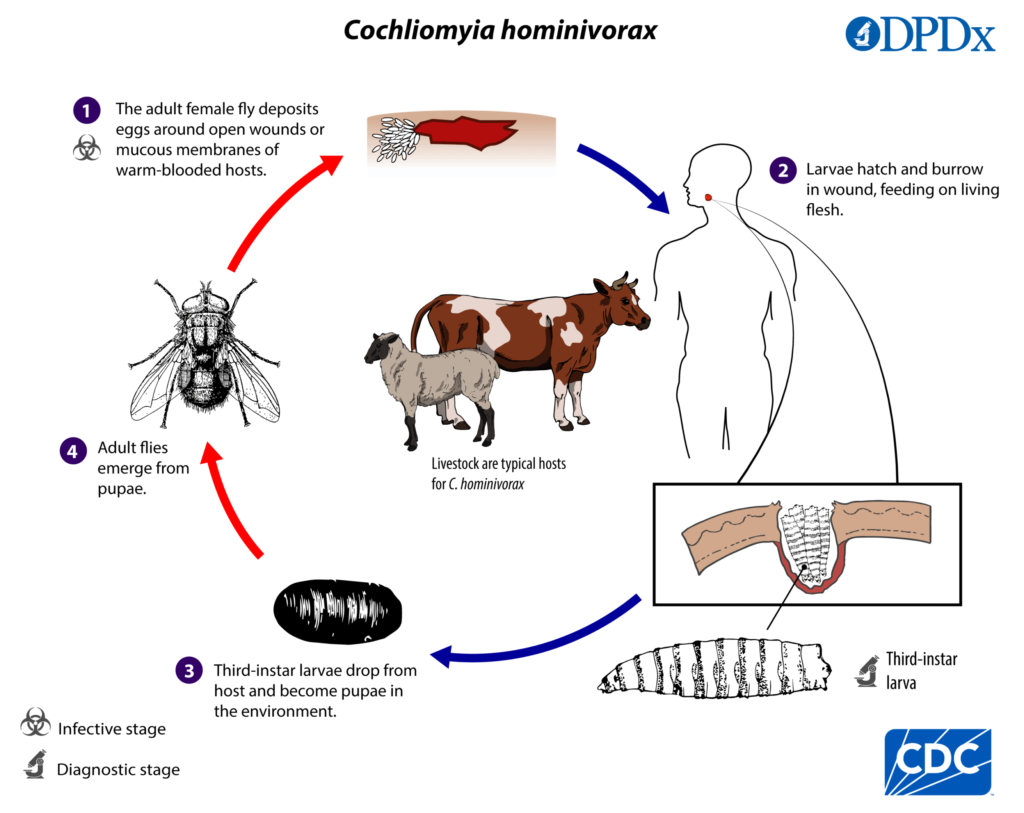
Adult screwworm flies are attracted to wounds and mucous membranes of live, warm-blooded animals.
Adult female screwworm flies lay their eggs in wounds or body orifices (e.g. eyes, ears, nasal cavity, mouth, genitalia, anorectal area, or a newborn’s umbilicus).
Eggs hatch into larvae.
Larvae burrow (screw) into the wound or body orifice and feed on living tissue.
Larvae feed for ~7 days, after which time they drop off the host onto the ground, burrow into the soil, and pupate.
Depending on temperature and humidity, the adult screwworm fly emerges from the soil ~7 to 54 days later.
Male flies mate within 24 hours, while female flies mate after 3 days.
The life cycle then repeats.
Hosts
While any warm-blooded animal is susceptible, the infestation primarily impacts large hooved livestock such as cattle, sheep, pigs, and horses.
NWS is observed less frequently in other species, including domestic dogs, birds, humans, and various wild mammals such as deer, rabbits, and opossums.
Adult Fly Characteristics
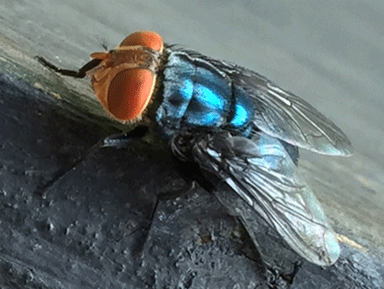
NWS flies are similar in size or slightly larger compared to the common housefly.
Larva Characteristics
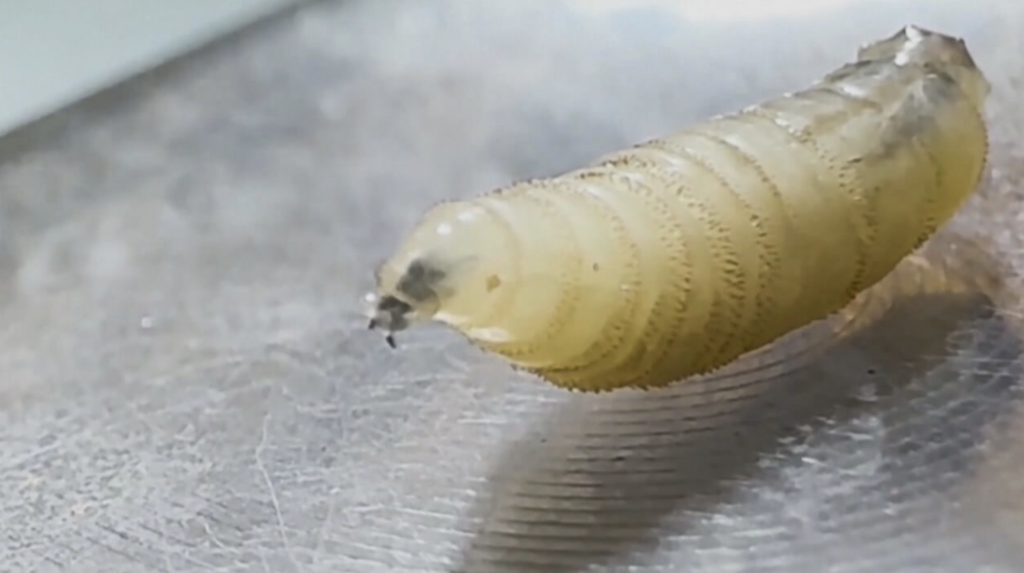
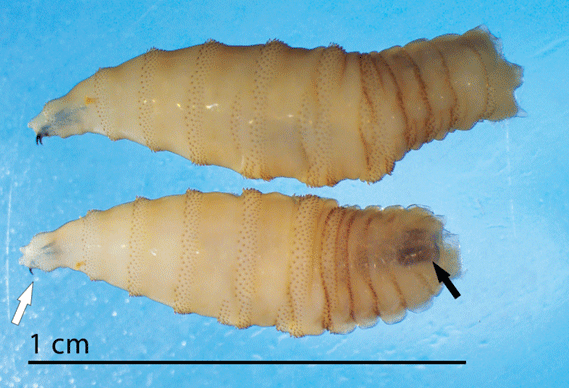
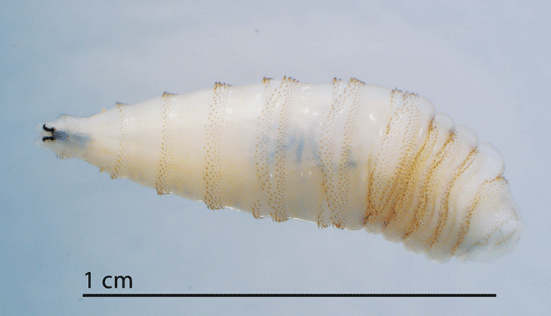
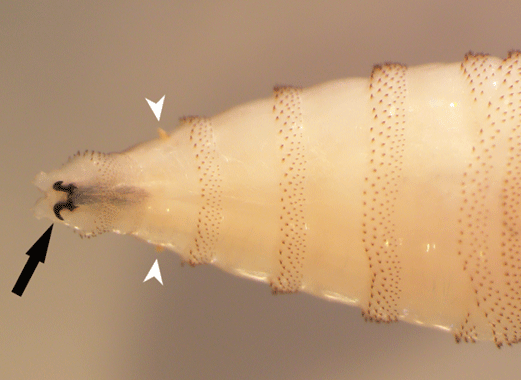
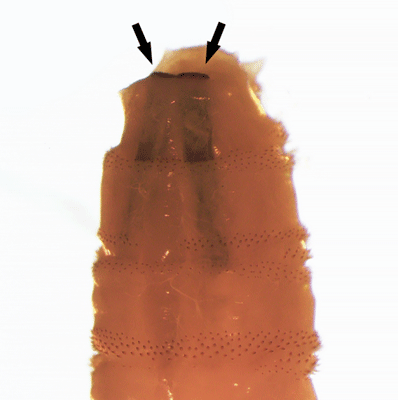
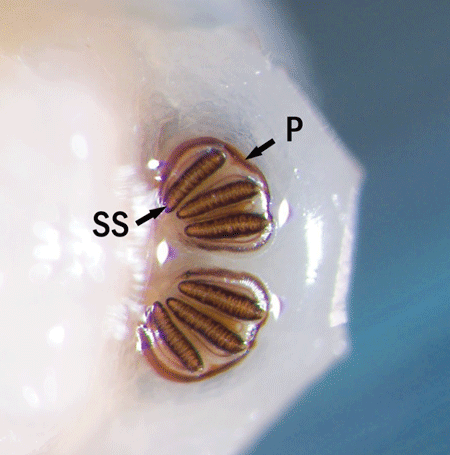
Third instar larvae are ~6.5 to 17 mm in length, muscidiform (tapering anteriorly and truncate posteriorly) in shape, with encircling bands of short 1- 2- and 3-pointed spines per body segment, and sharp, curved mouth hooks located anteriorly.
A characteristic particularly helpful in distinguishing NWS larvae from other species of larvae, include their dark tracheal trunks located posteriorly and posterior spiracular plates.
Clinical Signs
- Visible larvae (maggots) or white egg masses in wounds or body orifices (e.g. eyes, ears, nasal cavity, mouth, genitalia, anorectal area, or a newborn’s umbilicus).
- Movement sensation in wounds or body orifices.
- Swelling in otherwise heathy tissue.
- Rapidly progressing and painful wounds.
- Foul odor or the smell of decay from wounds.
- Sersosanguinous or bloody discharge from wounds.
- Pain (e.g. restlessness, irritated behavior, anxiety, continuously licking/chewing/looking at a specific area of the body, depression, not eating, and isolation).
- Secondary bacterial infections are possible.
- Attraction of flies.
- Fatal if left untreated.
Treatment
- Early detection is crucial.
- Physical removal of all larvae (maggots).
- Wound cleansing (e.g. dilute chlorhexidine).
- Wound debridement of necrotic tissue as needed.
- Cover all wounds, even very small ones.
- Consider insect repellent depending on the species and wound location.
- Antibiotics for secondary bacterial infections as needed.
- Analgesics for pain control as needed.
- Additional measures for dogs and cats: certain prescription flea and tick preventatives can help treat infestations.
Prevention
- Perform daily physical examinations to assess for the presence of any new wounds.
- Proper treatment of any existing wounds: clean and cover all wounds, even very small ones.
- Additional measures for people: prevent insect bites, wear protective clothing, and avoid sleeping outdoors.
- Additional measures for dogs and cats: certain prescription flea and tick preventatives can help prevent infestations.
Drugs for Prevention and/or Treatment
The U.S. Food and Drug Administration (FDA) has conditionally approved or granted emergency use authorization (EUA) of certain drugs for the treatment and/or prevention of NWS in certain species.
AVMA Summary of Drugs for Dogs and Cats (see AVMA’s post for the full list of all species):
Dogs
Credelio Quattro-CA1 (lotilaner, moxidectin, praziquantel, pyrantel) chewable tablets
- Status: Conditionally approved
- Indication: Treatment of NWS myiasis in dogs and puppies 8 weeks of age and older, and weighing 3.3 pounds or more
- Directions for use: Administer orally at the minimum dosage of 9 mg/lb (20 mg/kg) lotilaner, 0.009 mg/lb (0.02 mg/kg) moxidectin, 2.28 mg/lb (5 mg/kg) praziquantel, and 2.28 mg/lb (5 mg/kg) pyrantel (as pamoate salt). Must be administered with food.
Credelio (lotilaner) chewable tablets
- Status: Emergency use authorization
- Indication: Treatment of NWS myiasis in dogs and puppies
- Directions for use: Administer orally once a month at the recommended minimum dosage of 9 mg/lb (20 mg/kg). Must be administered with food.
NexGard (afoxolaner) chewable tablets
- Status: Emergency use authorization
- Indication: Treatment of NWS myiasis in dogs and puppies
- Directions: Administer orally once a month at the minimum dosage of 1.14 mg/lb (2.5 mg/kg).
Nitenpyram Tablets (nitenpyram)
- Status: Emergency use authorization
- Indication: Treatment of NWS myiasis in dogs and puppies weighing 2 pounds or more and 4 weeks of age or older
- Directions for use: For dogs weighing 2-25 pounds, orally administer one 11.4 mg tablet. For dogs weighing 25.1-125 pounds, orally administer one 57 mg tablet. In both cases, administer a second tablet 6 hours after the first. For effective treatment of NWS fly larvae in a wound, the product should be used in addition to larvae removal by the veterinarian. Pets may become reinfested following treatment.
Cats
Credelio CAT (lotilaner) chewable tablets
- Status: Emergency use authorization
- Indication: Treatment of NWS myiasis in cats and kittens
- Directions for use: Administer orally once a month at the minimum dosage of 2.7 mg/lb (6 mg/kg). Must be administered with food.
NexGard COMBO (esafoxolaner, eprinomectin, and praziquantel topical solution)
- Status: Emergency use authorization
- Indication: Treatment of NWS myiasis in cats and kittens
- Directions for use: Administer the entire contents of the provided unit applicator topically once a month at a minimum dose of 0.055 mL/lb (0.12 mL/kg), which delivers a minimum dose of 0.65 mg/lb (1.44 mg/kg) esafoxolaner, 0.22 mg/lb (0.48 mg/kg) eprinomectin, and 4.53 mg/lb (9.98 mg/kg) praziquantel.
Nitenpyram Tablets (nitenpyram)
- Status: Emergency use authorization
- Indication: Treatment of NWS myiasis in cats and kittens weighing 2 pounds or more and 4 weeks of age or older
- Directions for use: For cats weighing 2-25 pounds, orally administer one 11.4 mg tablet. Administer a second tablet 6 hours after the first. For effective treatment of NWS fly larvae in a wound, the product should be used in addition to larvae removal by the veterinarian. Pets may become reinfested following treatment.
Veterinarians prescribing the above drugs must inform clients/owners that these drugs are not fully FDA approved for the prevention and/or treatment of NWS, but rather are authorized on an emergency use basis, and must explain to clients/owners the risks versus benefits of these drugs.
Veterinarians must also maintain records including client/owner and patient information, product information, and specific EUA condition – refer to each product’s FDA Letter of Authorization for requirements of record keeping. These letters can be accessed here:
https://www.avma.org/resources-tools/one-health/veterinarians-and-public-health/new-world-screwworm/animal-drugs-preventing-or-treating-new-world-screwworm-myiasis
Eradication Efforts
Officials are reviving an eradication method that was successful decades ago by breeding sterile males flies and releasing them into the wild. When a sterile male fly mates with a female fly, her eggs will not hatch. Consequently, the population is expected to decline and hopefully disappear entirely.
References
https://www.cdc.gov/new-world-screwworm/hcp/clinical-overview/index.html
https://www.cdc.gov/dpdx/newworldscrewwormmyiasis/index.html
https://www.aphis.usda.gov/sites/default/files/nws-myth-busters.pdf
https://www.aphis.usda.gov/livestock-poultry-disease/cattle/ticks/screwworm
Featured Photo Credit: