
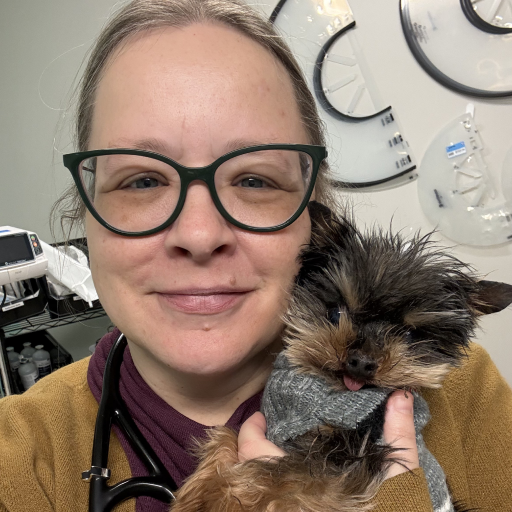



How did I solve the case of the $800 pyometra?
Penny was prescribed inexpensive antibiotics from a local pharmacy, as well as gabapentin and over-the-counter acetaminophen for pain relief. The following day, her owner called the local humane society, and they were able to add Penny in for emergency surgery. The cost was within the owner’s finances, and Penny recovered beautifully.
Does every story end this neatly? Absolutely not.
This story has ended in a tearful euthanasia.
This story has ended in a dog dying at home and a scathing Google review.
This story has ended without knowing what happened to Penny.
The point of this Vetpocket series isn’t to tell you how to diagnose and treat a pyometra. Of the many things we treat, pyometra is usually a straightforward diagnosis and surgery, with many patients leaving the hospital within 24-48 hours of recovery.
The point is to teach you how to care without carrying.
At the end of the day, Penny’s disease and her owner’s financial predicament are not your fault. Fixing the problem with limited resources is not your job. Providing the best medicine within the limitations you’ve been provided is your job.
In this case, if you didn’t have the ability to send to a local humane society, other options would have been explaining the guarded prognosis and discussing the potential for worsening sepsis, uterine rupture, and euthanasia as a viable option. Alternatively, prescribing oral antibiotics and pain relief potentially gives the owner time to crowd source funds. Both of those are fair approaches to this depending on your assessment of Penny’s comfort.
I can give you a dozen possible ways to help the situation and just as many outcomes. At the end of the day, what you must learn is that you are not responsible for the situation. You can only do as much as one veterinarian can do, at day’s end, you have to set down the weight.
Otherwise, veterinary medicine can break you. Compassion fatigue leads to burnout.
So what wisdom do I have to share after 18 years of this career?
Start building boundaries now. I’m sure you’re rolling your eyes. Boundaries is a buzz word we’ve all heard ad nauseum. But do you truly know what a boundary is and how to set one? A boundary doesn’t mean saying yes or no. It means understanding your value system and recognizing when you violate it.
Before boundaries must come values. Values are “the core beliefs and guiding principles that dictate how you behave, make decisions, and evaluate what is important in life.” (Google.com). Once you identify your value system, then a boundary can be set.
Understanding and defining your own values, as a veterinarian and more importantly, as a human being, will guide you. If this includes time with family and friends away from work, boundaries you set will protect that.
My personal values are centered around my family first and my work second. When I’m at work, I give my dedicated time and effort. When I leave at the end of the day, I no longer check emails, answer texts, or check test results.
This can become difficult in a field such as veterinary medicine, where the constant evolution of medicine requires us to stay on top of journals and research and the needs of our patients dominate our thoughts. But it can be done with a measured, thoughtful approach to our time and priorities. Set aside time to dip into your journals or Vetpocket or a tricky case, and when that time is over, move onto your next priority.
Learning to recognize when you’ve violated your boundaries is easier said than done, but with time it becomes easier. Stress in the workplace is often a sign that your values are not aligning with your behavior.
I’ll use Penny as an example.
I was very torn about her case. I wanted to offer to do a very discounted surgery at our office. My team supported this, but I felt the stress that it put on others. We would have to reschedule my afternoon appointments. We’d be staying later than usual. Penny was very sick, and the owner couldn’t afford the aftercare I feared she might need. The push/pull against my desire to help versus my desire to not disrupt the clinic’s flow told me what I needed to know.
I offered antibiotics and pain medications and told her to reach out to the humane service near us.
When I decided on this, there was immediate relief.
I make it sound easy. It isn’t, especially not as a young veterinarian with an open heart, brimming with the desire to dive in and ‘save the world.’ It’s taken me a long time to get here. Most of us got into this field because of a strong desire to help, and often, that can be to our detriment. But it is possible to be a dedicated, thoughtful, and compassionate veterinarian without losing yourself in this field.
If you are a new graduate, finding your way, I advise you to sit with these questions:
- What are your guiding values, not just as a veterinarian, but as a person?
- What boundaries can you set in your personal and work life to protect those?
- How do you recognize when you are violating your boundaries, and how can you protect against that?
Armed with this knowledge, I can promise you that while this field never gets easier, you will find meaning and purpose within it.
Read Part 1 of our series: Dear New Grad: A Series; The Art of Veterinary Medicine (Part 1 of 8)
Read Part 2 of our series: Dear New Grad: A Series; The Art of Veterinary Medicine (Part 2 of 8)
Read Part 3 of our series: Dear New Grad: A Series; The Art of Veterinary Medicine (Part 3 of 8)