

As I sit down to write this third article, I’m struck by the fact that this very scenario presented itself to me this week. I was able to experience yet again the stressful milieu of trying to provide care to animals when gasoline is $4/gallon.
Ms Smith has given you financial limitations for a life-threatening illness, and you have to figure out the best plan. So far, she has been polite but anxious about Penny’s health.
In our perfect world, we do all the tests. For a pyometra, this includes a full CBC, chemistry with electrolytes, a urinalysis to rule out concurrent UTI (a common scenario) with culture of the urine, PT and aPTT because of the risk of coagulopathy with severe infection/sepsis, screening chest xrays to rule out occult metastatic disease in an older dog, abdominal xrays, and abdominal ultrasound.
If diagnostics reveal a pyometra, then Penny would receive IV fluid therapy for several hours, IV broad-spectrum antibiotics and pain medications, and general supportive care until she is a good surgical candidate. She’d be hospitalized for 24-72 hours.
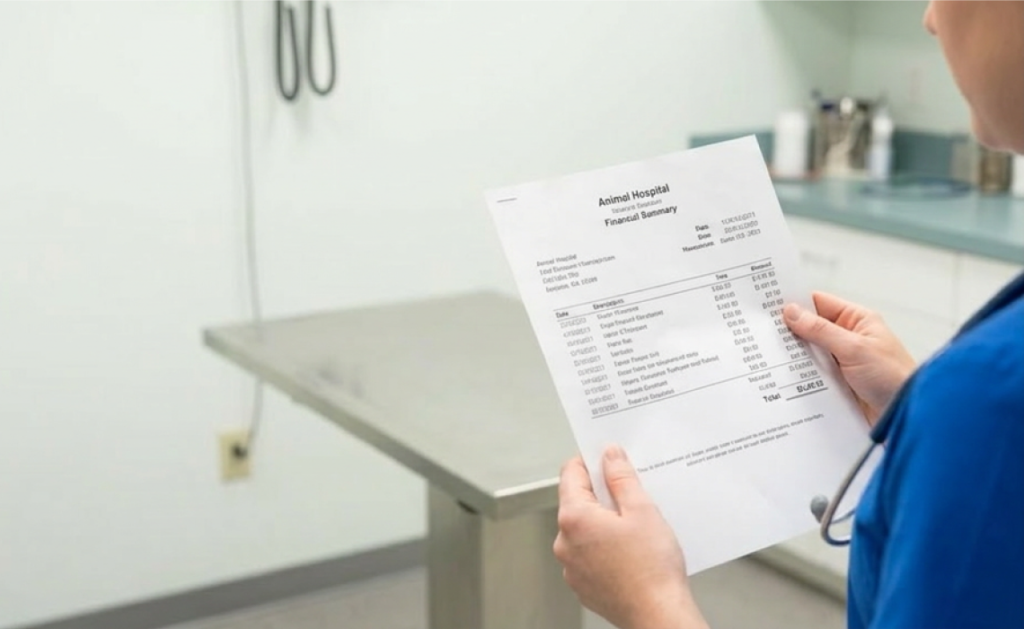
You have $800.
When you present the plan to Ms Smith, she’s angry about the cost of veterinary medicine, and she doesn’t hesitate to tell you. Her worried focus from Penny shifts to you, and she becomes angry. You’re feeling a little flustered, a little attacked, to be honest, because the owner is obviously worried about her dog, but she is misdirecting her anxiety and frustration onto you. You feel the urge to tell her that if she’d spayed her dog at an early age, this never would’ve happened. You want to tell her that you care deeply for Penny too, and you want to help, but you have no control over the cost of care.
And now we come back to the art of medicine. What can you do? What should you do? What is right?
In my case this week, I took the patient to the treatment area on some other pretext and popped an ultrasound on her for my own peace of mind. In this case, she did not have a pyometra.
But in many cases like this, I’ve checked in with my AVMF funds (if you are unaware, as an AVMA member, you have access to the AVMF grant to help clients with limited money. The application is very easy, and they are quick to process and send funds).
I’ve checked with local dog groups for emergency grants. I’ve talked to owners about CareCredit, Scratch Pay, and GoFundMes. I have reached out to colleagues about new graduates that need surgery experience in return for a discount on the procedure.
Then, I’ve “borrowed” the dog for a moment, “tripped” onto the ultrasound trough, and “dropped” an ultrasound probe on her belly.
In extreme cases, I’ve adopted an animal. My heart dog, a three-legged, absolute menace, came from such a situation.
Is this wrong? Is this bad medicine? Is it devaluing what we do and all the hard work it took to get us to this place?
I don’t know the black and white answers to these questions because we’re coming up against ethics, morals, standards of care, and finances for clinics and equipment we often don’t own. There will always be grey areas in veterinary medicine.
I’ve racked my brains for options in these cases. I have cared and I have carried.
And the name of that is burnout.
This is where we must learn the art. To care without carrying.
Do I still offer help to owners? Absolutely. I give them the options that I know, but I do not make this my fault or my decision. I’ve had the following conversation many times, including this week:
“Yes, Ms Smith, I understand that veterinary care is expensive. It can be very frustrating to feel like finances are preventing Penny’s care. Today, let’s focus on doing what we can do to get Penny’s problem diagnosed. Then we can talk about treatment options.”
When owners become contentious about expenses, I sympathize and then redirect the conversation. Validation will go a long way towards calming owners. Do not apologize for the costs. Acknowledge and direct the conversation back to Penny. Does it always work? No. Does it work most of the time? In my experience, kindness, validation, and sympathy go a long way towards calming owners. Remind them that you are working with them and not against them.
I would then opt for the most inexpensive imaging that we offer—whether that be a focused, one organ ultrasound or a two view abdominal radiograph series. This has the best chance of confirming our suspected diagnosis and giving the owner a firm answer.
Ms Smith approves the ultrasound, and we confirm that she has an enlarged, turgid, fluid-filled uterus.
Now what?
Stay tuned for part 4.
Read Part 1 of our series: Dear New Grad: A Series; The Art of Veterinary Medicine (Part 1 of 8).
Read Part 2 of our series: Dear New Grad: A Series; The Art of Veterinary Medicine (Part 2 of 8).