
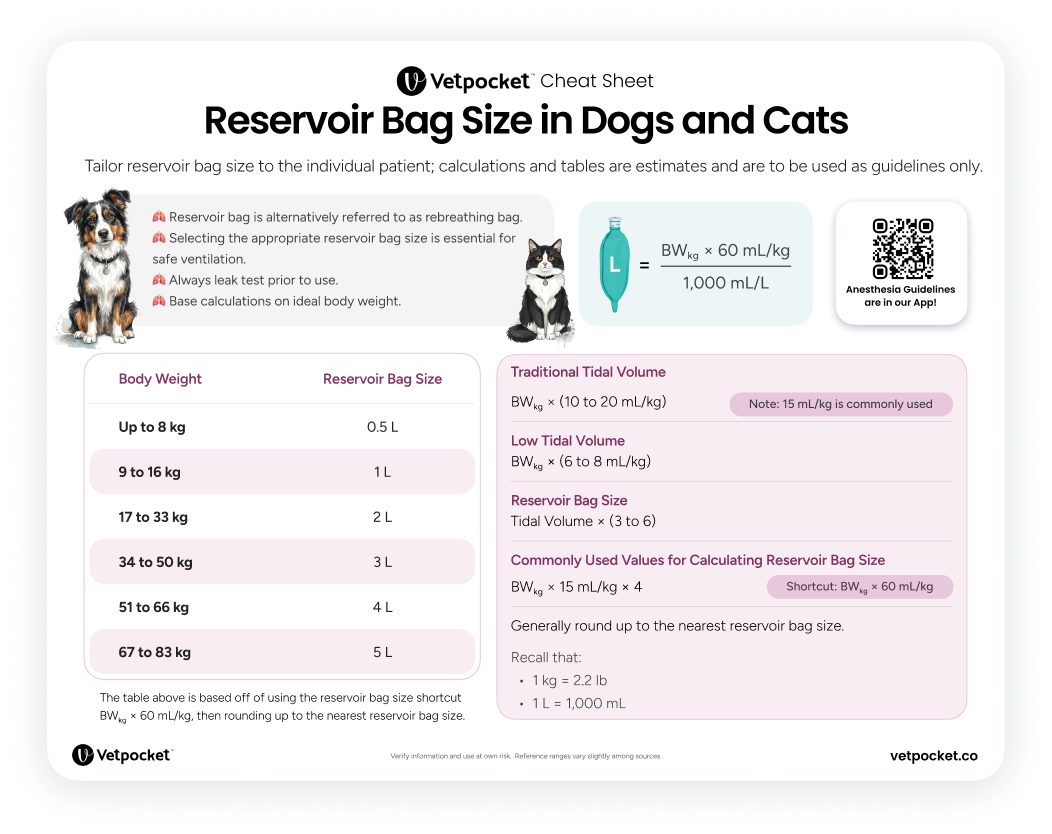
Anesthesia Reservoir Bag Size Chart & Quick Calculation Guide
When setting up an anesthesia machine for a surgical procedure, determining the correct reservoir bag size is one of the most critical steps for patient safety. Also known as a rebreathing bag, this essential component of your anesthetic circuit serves as a temporary gas storage reserve, allows you to monitor spontaneous ventilation, and enables manual positive pressure ventilation (IPPV) when needed.
Why Finding the Right Reservoir Bag Size Matters
Using an improperly configured reservoir bag size during patient maintenance poses serious clinical risks. If the rebreathing bag is too small, your patient may not have access to an adequate inspiratory volume during spontaneous breathing, causing the bag to empty completely with each inhalation. This restriction severely decreases alveolar gas exchange, leading to dangerous hypercapnia, hypoxia, and respiratory distress.
Conversely, choosing an excessively large reservoir bag size makes it incredibly difficult to monitor subtle respiratory movements, especially in small pediatric patients, and delays your ability to adjust anesthetic depth quickly. Additionally, manual ventilation using an oversized bag increases the risk of accidental pulmonary barotrauma.
Standard Anesthesia Reservoir Bag Calculation Formulas
In veterinary medicine, the volume of the rebreathing bag is traditionally calculated based on the patient’s estimated tidal volume ($V_T$). Performing a standard reservoir bag calculation ensures that the bag contains at least 5 to 6 times the patient’s tidal volume, providing an adequate buffer for breathing.
To determine the standard physiological requirements, clinical teams calculate the values using these multi-step equations:
$$text{Tidal Volume }(V_T) = text{Body Weight (kg)} times 15text{ mL/kg}$$
$$text{Standard Bag Volume (mL)} = V_T times 6$$
The Vetpocket™ Reservoir Bag Calculation Shortcut
In a fast-paced clinic setting, performing multi-step math can waste valuable time. To simplify your pre-anesthetic setup, Vetpocket uses a simplified, weight-based reservoir bag calculation shortcut:
$$text{Shortcut Volume (mL)} = text{Body Weight (kg)} times 60text{ mL/kg}$$
$$text{Required Bag Size (L)} = frac{text{Shortcut Volume (mL)}}{1000}$$
Simply take the patient’s body weight in kilograms, multiply it by 60, and convert the result from milliliters to liters ($1,000text{ mL} = 1text{ L}$). Finally, always round up to the nearest standard reservoir bag volume.
Clinical Example: For a 10 kg dog:
Multiply: $10text{ kg} times 60text{ mL/kg} = 600text{ mL}$ (or $0.6text{ L}$).
Round up to the nearest standard bag size.
‘Result: 1.0 L Reservoir Bag.
Quick-Reference Weight-Based Reservoir Bag Size Chart
To eliminate guesswork altogether during surgical prep, use this standardized weight chart to identify the correct reservoir bag size for dogs and cats:
| Patient Weight (kg) | Recommended Bag Size (L) |
|---|---|
Up to 8 kg |
0.5 L |
9 to 16 kg |
1.0 L |
17 to 33 kg |
2.0 L |
34 to 50 kg |
3.0 L |
51 kg and above |
5.0 L |
Note: Industry organizations like the ASPCA Pro Team utilize similar standardized weight ranges for shelter and clinical environments to ensure anesthesia safety.
Rebreathing vs. Non-Rebreathing System Sizing
The standard reservoir bag size guidelines described above are designed specifically for rebreathing (circle) systems. If you are anesthetizing a very small patient (typically under 7 kg) using a non-rebreathing system, different gas dynamics apply. While a 0.5 L bag is often standard for these small patients, close monitoring is essential. Always consult your clinic’s specific anesthetic protocols and verify your equipment is leak-tested before inducing any patient.
Get More Veterinary Cheat Sheets and Pocket Guides
If you want to stop searching for formulas on your phone mid-shift, check out our master Vetpocket Cheat Sheets Hub to find a full catalog of downloadable clinical guides, medical calculators, and reference charts.
For the ultimate analog upgrade, explore our physical pocket gear. Our clinical reference cards and custom badge reels place these exact, verified equations directly on your scrubs. Waterproof, clinical-grade, and designed to fit perfectly in your pocket, they help you focus on patient care rather than scrambling for calculations.