

Introduction
In order to appropriately treat a patient’s fluid abnormalities and maintain appropriate fluid balance, it is crucial to have an understanding of fluid physiology within the patient’s body.
Fluid balance is in a constant state of flux – constantly moving and shifting throughout the body. Water loss occurs through urinary loss, fecal loss, respiratory loss, vomiting, etc. Water gain occurs through food and water intake (and with certain disease states, when needed – fluid therapy administration).
Total Body Water
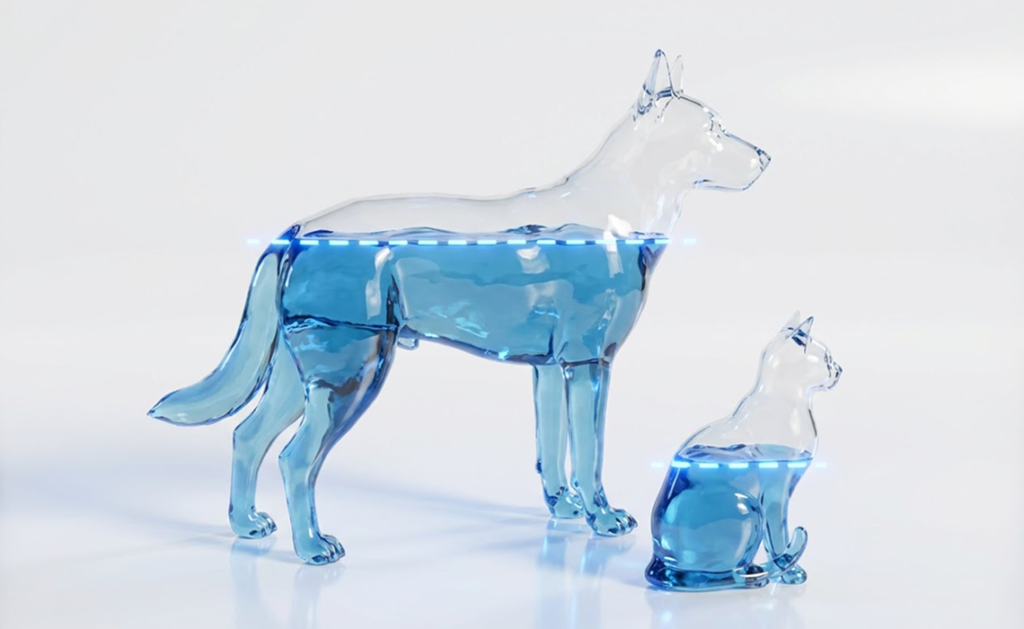
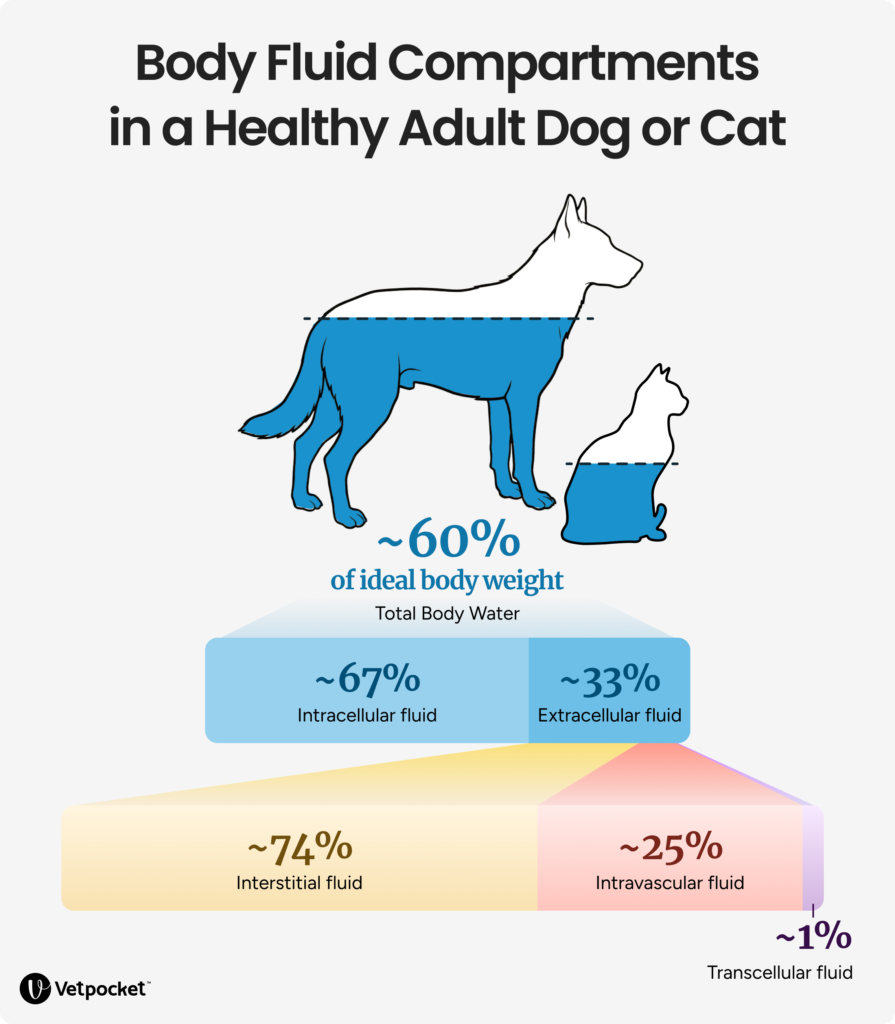
Just like humans are, dogs and cats are primarily made up of water. Total body water (TBW) represents the total volume of water contained within an animal’s body. TBW in a healthy adult dog or cat is ~60% of ideal body weight.
Note that neonatal dogs and cats have an increased volume of TBW. TBW in a healthy neonatal dog or cat is ~80% of ideal body weight. This Vetpocket™ article focuses on adult dogs and cats.
Body Fluid Compartments
TBW is divided into fluid compartments. These fluid compartments, made up of water and solutes, while physically interconnected, offer a useful conceptual framework for understanding the distribution of water and solutes within the patient’s body. Understanding what the different fluid compartments are and how osmosis occurs is instrumental in understanding how water and solutes move and shift throughout the body.
The differences in fluid compartments is key to comprehending the effects of different fluid therapy types and volumes – how different fluid therapy types and volumes can be utilized to best treat fluid losses from various fluid compartments.
TBW is divided into two main fluid compartments: the intracellular fluid (ICF) compartment and the extracellular fluid (ECF) compartment. The ECF compartment is further subdivided into three subcompartments (see below).
The Intracellular Fluid Compartment
The ICF compartment consists of fluid found inside cells, and constitutes the largest fluid compartment within the body. It is made up ~⅔ or ~67% of TBW (or ~40% of ideal body weight).
The Extracellular Fluid Compartment
The ECF compartment consists of fluid found outside cells, and is made up of ~⅓ or ~33% of TBW (or ~20% of ideal body weight).
The ECF compartment is further subdivided into: the interstitial fluid compartment, the intravascular fluid compartment, and the transcellular fluid compartment.
The interstitial fluid compartment lies between the vessels and the cells and consists of fluid that bathes tissues and cells. It constitutes the largest of the ECF subcompartments, and accounts for just under ~¾ or ~74% of the ECF volume (or ~24% of TBW or ~14% of ideal body weight)).
The intravascular fluid compartment consists of fluid found inside vessels (plasma), and accounts for ~¼ or ~25% of the ECF volume (or ~8% of TBW or ~5% of ideal body weight).
The transcellular fluid compartment consists of fluid produced by specialized cells to form cerebrospinal fluid, synovial fluid, peritoneal fluid, pleural fluid, gastrointestinal fluid, etc. It constitutes the smallest of the ECF subcompartments, and accounts for ~1% of the ECF volume (or ~0.3% of TBW or ~0.2% of ideal body weight).
Calculation Examples (note that these volumes are estimates)
A 10 kg healthy adult dog with ideal body weight:
- TBW = Body Weight in kg × 60% = 10 kg × 60% = 10 kg × 60/100 = 10 kg × 0.6 = 6 L
- ICF = TBW × 67% = 6 L × 67% = 6 L × 67/100 = 6 L × 0.67 = 4.02 L (another way to calculate ICF = Body Weight in kg × 40% = 10 kg × 40% = 10 kg × 40/100 = 10 kg × 0.4 = 4 L)
- ECF = TBW × 33% = 6 L × 33% = 6 L × 33/100 = 6 L × 0.33 = 1.98 L (another way to calculate ECF = Body Weight in kg × 20% = 10 kg × 20% = 10 kg × 20/100 = 10 kg × 0.2 = 2 L)
- Interstitial Fluid = ECF × 74% = 2 L × 74% = 2 L × 74/100 = 2 L × 0.74 = 1.48 L (1,480 mL)
- Intravascular Fluid = ECF × 25% = 2 L × 25 % = 2 L × 25/100 = 2 L × 0.25 = 0.5 L (500 mL)
- Transcellular Fluid = ECF × 1% = 2 L × 1% = 2 L × 1/100 = 2 L × 0.01 = 0.02 L (20 mL)
A 5 kg healthy adult cat with ideal body weight:
- TBW = Body Weight in kg x 60% = 5 kg × 60% = 5 kg × 60/100 = 5 kg × 0.6 = 3 L
- ICF = TBW × 67% = 3 L x 67% = 3 L × 67/100 = 3 L × 0.67 = 2.01 L (another way to calculate ICF = Body Weight in kg × 40% = 5 kg x 40% = 5 kg × 40/100 = 5 kg × 0.4 = 2 L)
- ECF = TBW × 33% = 3 L x 33% = 3 L × 33/100 = 3 L × 0.33 = 0.99 L (another way to calculate ECF = Body Weight in kg × 20% = 5 kg x 20% = 5 kg × 20/100 = 5 kg × 0.2 = 1 L)
- Interstitial Fluid = ECF × 74% = 1 L × 74% = 1 L x 74/100 = 1 L × 0.74 = 0.74 L (740 mL)
- Intravascular Fluid = ECF × 25% = 1 L × 25 % = 1 L x 25/100 = 1 L × 0.25 = 0.25 L (250 mL)
- Transcellular Fluid = ECF × 1% = 1 L × 1% = 1 L x 1/100 = 1 L × 0.01 = 0.01 L (10 mL)
Extravascular Fluid Compartment
Sometimes the term “extravascular fluid compartment” is used. This consists of fluid found outside vessels, or in other words, fluid excluding intravascular fluid.
The 60:40:20 Rule
A handy rule of thumb to help remember the fluid distribution throughout the body is the 60:40:20 rule: ~60% of ideal body weight is TBW, ~40% of ideal body weight is ICF, and ~ 20% of ideal body weight is ECF.
Principal Solute Distribution
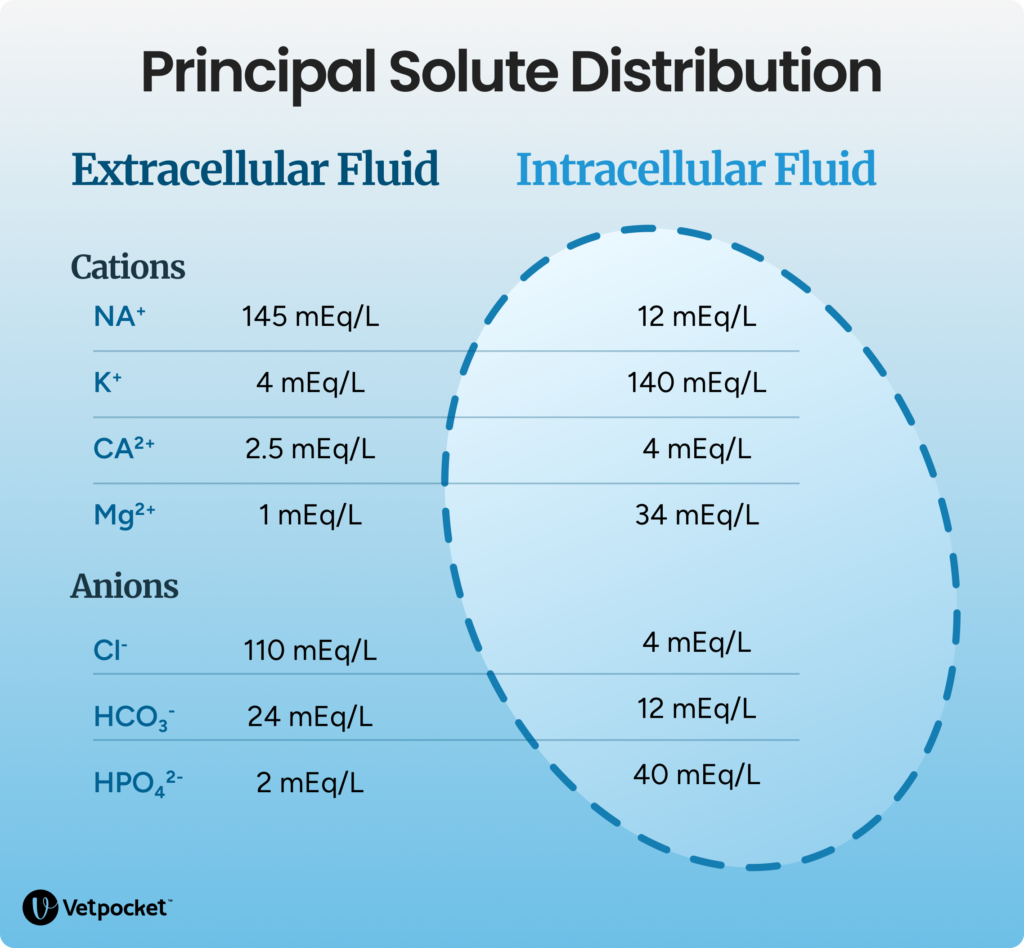
Solutes in each fluid compartment are not distributed homogeneously. Solute concentrations in the ECF compartment are very different compared to solute concentrations in the ICF compartment.
In the ECF compartment, sodium ion (Na+) is the principal positive ion (cation) and chloride ion (Cl–) is the principal negative ion (anion). Most of the total body Na+ and Cl– are located extracellularly (outside cells).
In the ICF compartment, potassium ion (K+) is the principal positive ion (cation). Most of the total body K+ is located intracellularly (within cells).
For example:
- ECF compartment: Na+ concentration ~145 mEq/L, Cl– concentration ~110 mEq/L, and K+ concentration ~4 mEq/L
- ICF compartment: Na+ concentration ~12 mEq/L, Cl– concentration ~4 mEq/L, and K+ concentration ~140 mEq/L
Homeostasis
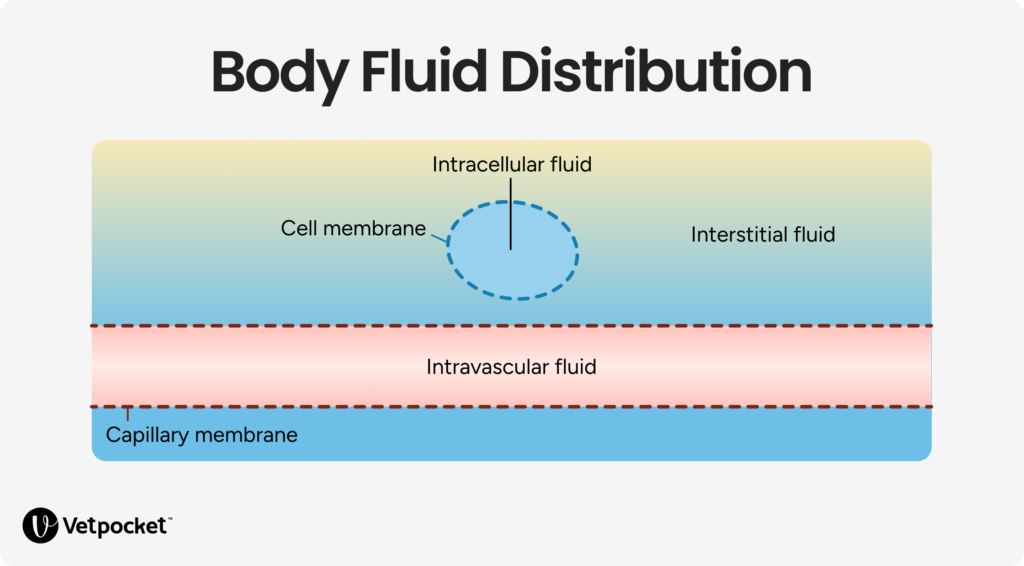
Homeostasis is maintained via constant regulation of water and solute movement between fluid compartments. One way in which this is achieved, is with the use of semipermeable membranes that separate the fluid compartments. These membranes include the capillary membrane and the cell membrane.
The capillary membrane separates the intravascular fluid compartment from the interstitial fluid compartment. This membrane is permeable to water and small molecular weight solutes (e.g. electrolytes, glucose, bicarbonate, and lactate).
The cell membrane separates the ICF compartment from the interstitial fluid compartment. This membrane is permeable to water, but tightly controls which solutes get in and out by use of transport mechanisms (e.g. specialized pumps and channels).
Conclusion
Different disease states can cause fluid losses from different fluid compartments. Familiarity with different fluid compartment compositions and the ability to estimate volume loss from specific fluid compartments are essential for helping initiate an appropriate fluid therapy treatment protocol for a patient.
By visualizing the body’s water as a series of interconnected, yet distinct, fluid compartments, clinicians can strategically select the appropriate fluid therapy type and volume to administer in order to help restore balance, and help support essential bodily functions.
Stay tuned for “A Comprehensive Guide to Understanding IV Fluid Therapy, Part 3: How do Water and Solutes Move?”.
References
- DiBartola, S. Fluid, Electrolyte, and Acid-Base Disorders in Small Animal Practice, Fourth Edition. Elsevier Saunders, 2012
- Ettinger S, Feldman E, Cote E. Textbook of Veterinary Internal Medicine, 8th Edition, Elsevier, 2017
- Pardo M, Spencer E, Odunayo A, et al. 2024 AAHA Fluid Therapy Guidelines for Dogs and Cats. J Am Anim Hosp Assoc 2024 Jul 1:60(4):131-163
- Davis H, Jensen T, Johnson A, et al. 2013 AAHA/AAFP Fluid Therapy Guidelines for Dogs and Cats. J Am Anim Hosp Assoc 2013 May-Jun;49(3):149-59
- Silva C, Pedro M. Intravenous fluid therapy: essential components and key considerations. Porto Biomedical Journal 10(4):e296, July/August 2025
- Dr. Danelia de Kock’s Veterinary School notes
Read Part 1 of our series: A Comprehensive Guide to Understanding IV Fluid Therapy in Dogs and Cats, Part 1: What is IV Fluid Therapy?