

Introduction
Welcome to Dear New Grad!
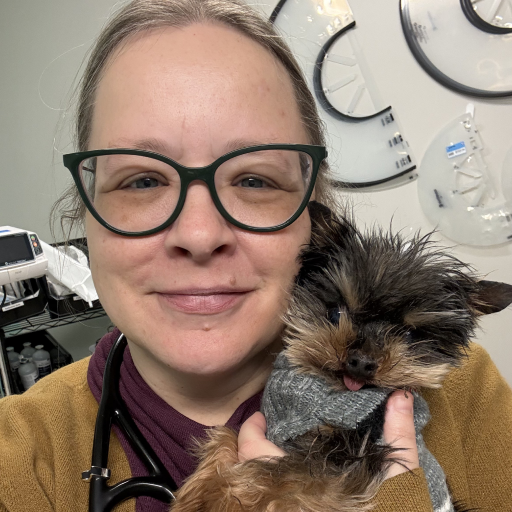
Let me introduce myself. My name is Dr Catherine Ashe, and I graduated from the University of Tennessee in 2008.
To my great surprise, I went into a private internship that gave me a deep love for emergency medicine.
Over the past 18 years, I have worked in the trenches of ER and general practice, spent two years in home euthanasia, volunteered serving pets of the homeless, written articles for numerous publications, taught in a technical program, and looked for ways to mentor young veterinarians.
The Goal with this Series
My goal with this series is to teach the art of veterinary medicine.
We leave school with a strong understanding of practice – the anatomy and physiology of animals, disease processes, and diagnostic tests and treatment.
What we don’t learn is the art of medicine, defined as the humanistic, individualized, and relational aspects of the job.
In a slightly less clinical way, no one teaches us how to talk to owners, how to set healthy boundaries, how to get by without every diagnostic test, and how to feel comfortable with our medical decisions.
Looking Back
If there is one thing I’ve learned in 18 years of vet med, it’s that people are the driving force behind it. Without owners, we would have no patients.
This job begins with our love for animals but it depends on our ability to connect to their humans. And it takes time, practice, and refinement to get there.
I remember as a newly minted vet that there were plenty of articles about how to evaluate patients—what tests to order and what treatments to consider.
What I didn’t learn was that a visit begins the moment a client walks through the door, that appointments may be limited to 20 minutes, and that clients may be significantly financially constrained.
Looking Forward
So, where does a new grad begin?
With compassion, an open heart, and a willingness to meet owners where they are.
With the knowledge that we are practicing in the real world, with all its limitations: financial, emotional, personal, and ethical.
And lastly, with belief in ourselves, our education and skills.
What does that look like in a clinical setting?
It starts with that first interaction with a client.
As a young vet, the hardest thing for me to unlearn was judgment. I am still humbled by the lesson every single day. It’s easy to look at a client’s clothing, the condition of their pet, their history of care (or lack thereof) and make snap decisions.
It’s easier to avoid presenting Plan A, because you think an owner can’t afford it, and jump straight to Plan C.
There are many shortcuts that naturally happen when we start with baseline assumptions.
As a veterinarian and leader within our clinics, it is our job to set an example, and leading our staff is the first step to doing good medicine.
The Art of the Job
So, we’ll start with a scenario and work through this over the next few articles.
A client steps through the door with an older, intact female dog that’s lethargic and vomiting. She hasn’t been seen by your clinic in four years and has received no preventive care elsewhere.
Where do we begin? How can we get this appointment off to a good start?
Here are my thoughts:
1. Bias is normal. We all make judgments hourly. It’s how we navigate the world and decide what is safe and what isn’t. Trying to be unbiased will fail. Instead, we should recognize our bias and interrupt the behavior. When you start to make assumptions, or your staff does, pause and interrupt that thought process. A gentle redirect with “we might be making too many assumptions here” is effective without being punitive.
2. Choose your words wisely. Avoid talking about clients in a negative way. I can’t count the number of times I’ve assumed a client would decline everything only to have them surprise me and approve every test, despite the cost. Train support staff to give a history without editorializing or interjecting opinions.
3. Be curious. I find that talking to clients openly and honestly goes a long way toward avoiding misunderstandings and frustrations. I make sure to ask “what is your main concern today?” and when finances seem to be an issue, I often ask, “what do you feel comfortable working with today?” At the end of a visit, I make sure to check in with owners, often asking “do you feel like we’ve covered all of your concerns? Did we miss anything?”
4. Make the same recommendations no matter your assessment of the client. We start with Plan A and go from there, while making sure owners know the risks and benefits of each.
5. Remember: Offer the same kindness. Offer the same options. Accept different paths.
With these ideas in mind, we’ll move to part 2 about starting this appointment off on the right foot.
Read Part 2 of our series: Dear New Grad: A Series; The Art of Veterinary Medicine (Part 2 of 8).